|
How does our Australian Parliament work? How do federal, state and local governments make legislation about the climate and environment? And how can we as Australian citizens best influence our elected representatives and parliaments to make good decisions about our future? In Australia, we are fortunate to have a robust representative democracy with elected representatives at all levels of government. However, we have more trust in government decision making when we are part of the conversation. For democracy to function well, we need to be active participants. Engaging in democracy is relatively simple, yet can be remarkably powerful. Here are some of the basics to help you understand how it works, with links to more detailed information if you need it. |
How do government polices affect action on climate and environment?Federal, state and local governments have a duty to make laws that look after all Australians, both in the present and for future generations. This includes legislation and planning for the consequences of climate change. Our governments set carbon emission reduction targets in line with international agreements, and across emissions sectors including energy and transport to make sure our emissions go down. Federal and State laws impose ceilings on pollution for industry and mining, and are responsible for deciding who gets licenses and permits for fossil fuel exploration, mine expansions and new projects. Local governments are responsible for urban planning at community level to mitigate the effects of extreme weather, manage waste, and implement sustainable infrastructure. Legislation enshrines our right to protest if we're not happy with government decisions. Across all portfolios, government decision-making needs to take into account the effects of a warming climate on everything from our health and housing, to our transport and the environment. |
 |
||
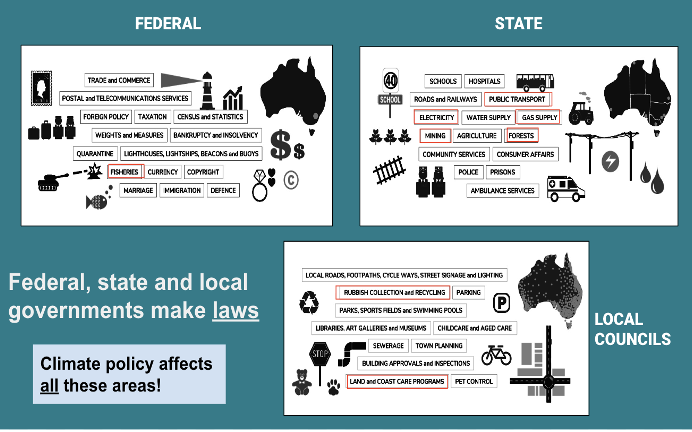
Which governments make decisions about climate in Australia?In Australia, there are three levels of government - federal, state, and local. Each has different portfolios or areas of responsibility, though there is some overlap. The federal, or Australian government, is the senior level of government and can make laws for the whole of Australia, while the six state and two territory governments (NT and ACT) can make laws only for their respective jurisdictions. Local governments make laws at community level for their respective council or shire municipality. There are some areas both the federal parliament and state and territory parliaments can make laws about, including Climate and Environment. If the federal parliament and a state parliament make laws about the same thing but these laws don’t agree, the Australian Constitution says the federal law will be followed and the state law will be removed. The three levels of government often work collaboratively on climate and environment issues. For example, in regard to renewable energy, the federal government sets national emissions targets and allocates funding, state governments have policies such as transitioning the state's power grid and incentives for transitioning households and businesses to electrify, and local councils implement community-level adaptation and sustainability projects such as switching swimming pools to electric heating, and installing electric vehicle chargers.
State and territory governments hold most of the legislative powers for fossil fuel mining and other major project approvals. However, the federal government has some powers to overrule on environmental grounds. |
 |
How do governments and parliaments actually work?The overarching government system in Australia is Federal parliament, which has a 'bicameral' or two-house parliamentary system. Voters elect representatives to both houses - the House of Representatives and the Senate. A similar system operates in most states, although Queensland and both the territories only have one legislative house. Local governments are much smaller, having an average of nine elected members (or councillors) to oversee their local council or shire. How does federal parliament work?The House of Representatives, often called the Lower House, is where the federal government is formed. The House currently has 150 members, each representing an electorate of (on average) 120,000 voters. Members are elected for a three-year term. The political party or coalition with the majority of seats forms the government, and its leader becomes the Prime Minister. The House debates and votes on proposed laws (bills), and holds the government accountable through question time, debates, and parliamentary committees. The Senate, also called the Upper House, consists of 76 senators: 12 from each of the six states and two each from the ACT and NT. State senators serve staggered six-year terms, with half of them up for election every three years. The four territory senators serve three-year terms. The Senate plays a key role in reviewing, amending, and passing - or rejecting - legislation proposed by the House of Representatives. It also provides checks and balances on the government by holding inquiries, scrutinising bills, and representing the interests of the states and territories at federal level. Commonly asked questions about the Australian parliament are addressed by the Parliamentary Education Office.
|
 |
 |
|
How are laws about climate made?One of the main roles of our parliaments is to make laws. At national level, federal parliament determines what will become law by passing legislation through the House of Representatives and the Senate. A proposed law, called a bill, is introduced to one house and if passed, the bill moves to the other house for review. It can take weeks or months for a bill to pass the Australian parliament - however sometimes they can be passed in a matter of days. Once Parliament passes a bill, it has to be given 'Royal Assent', meaning it is signed into law by the Governor General. This is a procedural convention as no Governor General has ever refused to sign a bill, although on rare occasions they have recommended changes.
State and territory parliaments follow a similar process. This Auspol video describes how federal and state parliaments around Australia make laws. Municipal councils act as a unified body to debate and make decisions and laws collectively through a simple majority vote during formal council meetings. |
 |
What is our elected MP’s job?
The Australian Constitution contains the rules about how members of parliament are elected and the terms of their service but does not cover their day-to-day role. Local councillors work as a collective group to manage budgets and make decisions reflecting the needs of their communities. They are available to meet with residents and local business owners to hear their views and concerns, and act as a bridge between residents and the council's administrative organisation. |
 |
||
How does voting work?Federal elections in Australia are conducted by the Australian Electoral Commission (AEC), which is an impartial and independent statutory authority governed by the Commonwealth Electoral Act. State, territory and local council elections are run by similar electoral management bodies in accordance with separate legislation. On election day, polling booths are set up across each electorate, although some people choose to vote early at special early-voting booths or by post. More than 97% of eligible voters in Australia are registered to vote, equalling more than 18.25 million people. It is mandatory for citizens to vote in all Australian elections, and you can get a fine if you don't. The way you rank the candidates on the ballot paper matters. Australia's preferential voting system ensures no vote is wasted and all preferences are taken into account. There are more detailed explanations of how the preferential system works here, here and here. Votes are counted manually in Australia, which is time-consuming and complex but considered to be transparent and highly accurate, and we can be proud that our system is respected as one of the best in the world.
|
 |
What is our first responsibility as democratic citizens?In our representative democracy, our number one responsibility as citizens is to vote in regular state, federal, and municipal elections. In Australia, voting is compulsory for all citizens over the age of 18, which ensures high electoral participation. The first step to voting is to make sure you are on the electoral roll for your federal and state electorates, and local municipality. So, how do we choose who to vote for? Which candidate or party will best represent our views and concerns, particularly on climate and environment? Before election day, it's important to check out the candidates in your electorate and find out what their views are on the issues you care about, such as climate and environment. You can do this online or at candidate forums and events in your electorate. Another way to discover how your local candidates and parties are approaching the issues you care about most is via Project Planet's non-partisan Build a Ballot website, which launches a few weeks before every State and Federal election and has researched all the candidates. Through a series of questions, the site then helps you plan your own preferences, ready for election day.
|
|
|
|
|
Why does all this matter and how can I play a role?Being an active participant in our democracy is relatively simple, yet can be remarkably powerful. We're not alone. Individual actions make a difference. Policy changes about climate and environment happen because:
There is power in numbers when multiple people raise concerns about the same issue because sustained community engagement helps shape party priorities that ultimately lead to better climate policy. Here are some ways to get started. Follow the links for tools and resources to help.
|
 |
What if I can't vote? What non-voting participation can I have in our democracy?Citizen democracy refers to the active participation in democratic processes beyond just voting. You don't have to be enrolled to vote to get involved - if you're under 18 or not an official Australian citizen, you can still take part. We have the opportunity to engage in democracy in between elections at every level and stage of the political process to keep our governments and MPs accountable. Non-voting participation includes written and face-to-face dialogue with our elected representatives, submissions to parliamentary inquiries, feedback on public consultations, petitions and peaceful protests. Australia’s democratic system encourages freedom of speech, the right to protest, and open access to information, which allows citizens to influence policies, hold leaders accountable, and contribute to shaping laws and decisions that affect their lives. Here are just a few examples of successful climate and environment campaigns by concerned people and organisations that have resulted in positive change.
|
|
|
|
|
Links for further information |
||
|
Australian Parliament House info sheets Parliamentary Education Office |
Explanatory videos from Auspol explained |
|
|
|
|
|


 There is no formal job description that defines