
|
|
|
There are a range of gas projects currently underway in the North West of WA. In May 2025, Environment Minister Murray Watt approved the extension of the North West Shelf project to 2070, a hugely disappointing decision. But there is still so much to fight for in this region. Woodside’s proposed gas project in the Browse basin, 425 km north of Broome and 260 km off the Kimberley coastline, is an area home to an enormous diversity and abundance of marine life. The project is notable for both its scale and the serious environment and climate risks it poses. |
|
|
|
|
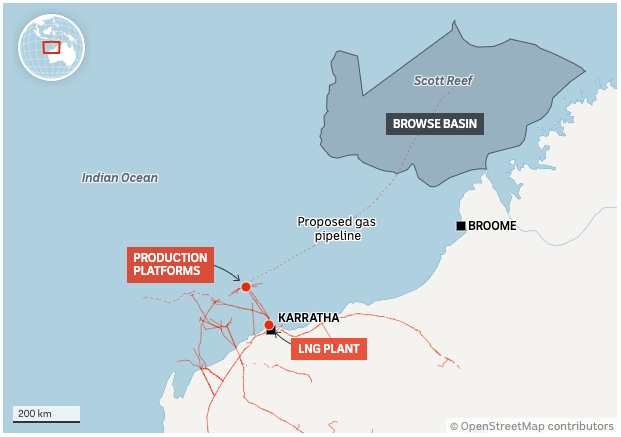
Background and context Despite clear scientific warnings and international obligations to reduce emissions and protect ecosystems, new fossil fuel projects continue to be proposed and progressed in Australia. On Wednesday 28 May, Environment Minister Murray Watt announced he was approving the extension of Woodside’s gas operations on the North West Shelf by 40 years to 2070. This is very disappointing news - but there is still so much to fight for to stop Woodside expanding even further. In particular, it is critical to oppose Woodside’s application to extract gas from the Browse Basin. The Browse Basin, which can be seen on the map below, is one of Australia’s biggest untapped gas reserves. If approved, the Browse gas project would emit more than three times Australia’s annual emissions. It also threatens the pristine Scott Reef, and invaluable Indigenous cultural heritage. Although the Northwest Shelf extension has been approved, Woodside's proposed Browse gas project has not been approved federally or by the Western Australian state government. Crucially, the Browse project is a crucial part of Woodside’s plan to supply the North West Shelf, and if it is not approved, it would make extension of the Northwest Shelf to 2070 less profitable. So, it is more important than ever to put pressure on our government to say no to Woodside.
Map Source - OpenStreetMap
Glossary of names
This briefing focuses on the Browse proposal, as it is the next major pending approval. Why is this important? The Browse proposal further threatens unique ecosystems, and cultural heritage in the region, in particular Scott Reef and the Murujuga World Heritage Listed site. Scott Reef The Browse basin is approximately 425 km north of Broome and 260 km off the Kimberley coastline. It is home to enormous biological diversity, and abundance of marine life including 39 rare and endangered species like pygmy whales and sea snakes. Woodside proposes drilling near Scott Reef, which would create significant threats to wildlife through noise pollution, including the risk of subsidence (land sinking) of the Sandy Islet where green sea turtles nest, and the risk of leaks or oil spills. Murujuga Cultural Heritage Area The Murujuga heritage site in the Pilbara features more than 1 million petroglyphs (images etched into rock) that date back 50,000 years. This includes the world's oldest depiction of a human face. In July 2025, UNESCO approved world heritage listing for Murujuga after decades of campaigning from Indigenous groups. However, UNESCO warned that Murujuga is under threat due to Woodside’s nearby industrial developments. In particular, acidic emissions are causing degradation of the rock art. The 40 year extension of the North West Shelf project, and other expansions proposed by Woodside, puts this art at further risk. The Browse Proposal The proposal would include two floating production storage and offloading facilities, and 900 km of pipeline to connect the new infrastructure to the existing Karratha Gas Plant. Although the proposal also includes a carbon capture and storage component, which Woodside claims would offset a small percentage of overall emissions from the project, many groups have labelled this as greenwashing. As part of the approval process for this project, Woodside submitted an environmental assessment to the Western Australian Environmental Protection Authority (EPA) in 2022. More than 20,000 public submissions were lodged in response to this proposal, and in February 2024, the EPA deemed the project “unacceptable” due to its impact on marine life at Scott Reef - a remarkable move for an Authority that has recommended against only two of 10 oil and gas proposals since the mid-1980s. Woodside submitted an amended proposal to the EPA with changes to attempt to reduce the project’s environmental impact, though major concerns remain. The EPA re-opened the project for public consultation from May - June 2025. Approval process The WA EPA is responsible for the assessment and approval of the parts of this project that lie in state waters, which predominantly includes the areas around Scott Reef. Separate federal approval must be gained for those parts in Commonwealth waters. Following the consultation period, the EPA will decide whether to accept the amended proposal and allow Woodside to change aspects of its submission. If it is accepted, the EPA will begin scientific examination of the environmental risks of the amended project to determine if the Browse project is environmentally acceptable. Ultimately, the Browse project and North West Shelf extension remain fundamentally incompatible with Australia’s climate commitments. With a proposed end date of 2068, the approval of this project will lock Australia into a long-term fossil fuel future, which we know will undermine global efforts to limit warming to 1.5°C and delay the urgent transition to renewable energy. In summary:
Desired outcomes:
Who to contact
Resources:
Actions you can take: 1. Email your MP or relevant Ministers If you need some help getting started with your email, here is an example. Please don’t copy it exactly - personalise it and tailor it to the MP you are writing to. In addition, when writing to a Minister or Shadow Minister, start by saying that you’re writing to them in their role as Minister for xxxx, otherwise they will probably just forward your email to your local MP. |
|
[MP name] [Member for …. or Minister for ….] Dear … [Include a personal statement - who you are and why you care] Despite clear scientific warnings and international obligations to reduce emissions and protect ecosystems, new fossil fuel projects continue to be proposed and progressed in Australia. Among them is Woodside’s Browse gas project, notable for both its scale and the serious environment and climate risks it poses. Despite initially being rejected by the Western Australian Environmental Protection Authority because of the devastating impacts this project may cause to critical marine habitats like Scott Reef, Woodside has amended its proposal and is again seeking approval for this damaging project to go ahead. This amendment does not adequately address climate and environment risks of this project, and Woodside’s proposed minor changes must not be seen as justification for the project’s continuation. The relocation of certain infrastructure reduces proximity to Scott Reef but still poses significant risks to marine ecosystems, including noise pollution, subsidence, sediment disturbance, vessel strikes, and the potential for toxic discharge and uncontained spills in critical marine environments. This would have devastating impacts on any of the 39 threatened species that live in this area, including green turtles that nest and feed in the region, whales that migrate through each year, and the corals and fish that call the reef ‘home’. Most importantly, the Browse project remains fundamentally incompatible with Australia’s climate commitments: with a proposed end date of 2068, the approval of this project will lock Australia into a long-term fossil fuel future, which we know will undermine global efforts to limit warming to 1.5°C and delay the urgent transition to renewable energy. Fossil fuels must stay in the ground if we are going to avoid the worst impacts of the climate emergency and meet our national emissions reduction targets. Will you call for the Western Australian Environmental Protection Authority to reject the proposal? What steps will you take to protect Scott reef, the surrounding marine environments, and the animals that call this area home? Will you commit to no new fossil fuel projects to help meet our national emissions reduction targets and avoid the worst impacts of the climate emergency? I look forward to your response. Sincerely Name Address Phone (required if you want a reply) |
2. Call your MP or Minister
Here is a suggested script to get you started:
|
Hi, my name is ….. and I’m a voter in [your electorate]. I’d like to speak to …..[name of MP] (Staffer will probably say: I’m sorry they’re not available, can I take a message?) Yes, thank you! Would you please tell them that:
And ask them to:
Thank you! |
3. Visit your MP
Email your MP’s electorate office to ask for a meeting and follow up with a phone call a few days later. Get help on how to do this under the Democracy and Governance heading on our Climate briefings webpage.
(Last updated July 2025. Thanks to the Conversation Council of Western Australia for their input.)
 Get informed:
| AUSTRALIAN PARLIAMENT: HOW ARE LAWS MADE? |
|
One of the main roles of our parliament is to make laws, and parliament determines what will become law by passing legislation through the House of Representatives and the Senate. A proposed law, called a bill, is introduced and goes through three readings: the first to introduce the bill, the second to debate and possibly amend the bill, and the third is for a final vote. If passed, the bill moves to the other house for the same process. It can take weeks or months for a bill to pass the Australian parliament - however sometimes they are also passed in a matter of days. Once Parliament passes a bill, it has to be given ‘Royal Assent’, meaning it is signed into law by the Governor General. |
 Australia’s legislation pathways