Continue to call on the government to not only meet, but exceed Australia’s 2035 emissions reduction targets by reinforcing policy frameworks and implementation mechanisms that deliver genuine, long-term emissions abatement.

CLIMATE BRIEFING

While Australia’s 62–70% emissions reduction target for 2035 is a step forward, it falls short of what science says is needed to protect people, the environment, and the economy from severe climate risks. Meeting and exceeding this target through ambitious policies and programming will help avoid the worst impacts of climate change.

This climate briefing is part of our series of simple, easy-to-follow guides and email templates on big climate topics for Australia. They’re designed to help you get across the issues, feel more confident speaking up, and make it easy to send a message to your MP about the things you care about.

Background/context:

On 18 September 2025 the Australian Federal Government announced a new national target to reduce emissions by 62% - 70% below 2005 levels by 2035. Adopted in 2025 as part of Australia's updated Paris Agreement commitment and informed by the recommendations of the Climate Change Authority, this target is intended to provide an “ambitious, achievable and “credible contribution” towards deeper decarbonisation. 


Despite being considered an achievable target that can keep the country on track for a safe and prosperous future, scientists, economists and climate advocates argue otherwise. In a 2025 review the target is said to fall short of what is required to align with 1.5°C pathways and adequately protect Australia from escalating climate impacts. 


The 62% - 70% target is in line with 2°C of warming above pre-industrial levels. According to the government’s own National Climate Risk Assessment - released shortly before the 2035 target announcements and plans to be reaffirmed in subsequent 2026 climate reporting, such trajectory places the nation at significant risk of worsening climate impacts including:

  • More than double the amount of time spent in heatwaves compared to today
  • Marine heatwaves increasing to nearly 100 days duration
  • Significantly increased risk of drought and fire across most parts of the country
  • An additional 0.32m of sea level rise, and hundreds of thousands more people at risk of coastal flooding
  • Severely increased risk to every aspect of our society, including primary industries and food, the economy, national security and defence, health and social services, infrastructure and - of course the environment


The Environmental Defenders Office’s independent legal and scientific analysis determined the target does not represent Australia's fair-share contribution to limiting global warming, not reflecting what the climate science and legal obligations demand to adequately protect the nation from escalating climate risks, and called for far steeper reductions and net zero by 2035 to meet Australia's commitment to the Paris Agreement. The target is additionally weakened by an unusually inflated baseline, as emissions in 2005 were unusually high due to extensive land clearing.


It’s still important we meet the target, as every tonne of carbon kept out of the atmosphere contributes to minimising climate damage. However, it should be considered a bare minimum, and the current 62%–70% target should be considered a floor rather than a ceiling, and the government should implement ambitious, science-aligned policies to exceed the upper limit and put Australia on a credible path to net zero. The Climate Council maintains that to align with climate science and avoid the worst impacts of climate change, Australia should be aiming for 100% emissions reduction, or net zero by 2035, rather than 2050, alongside stronger interim targets.


This could be achieved through measures such as: 

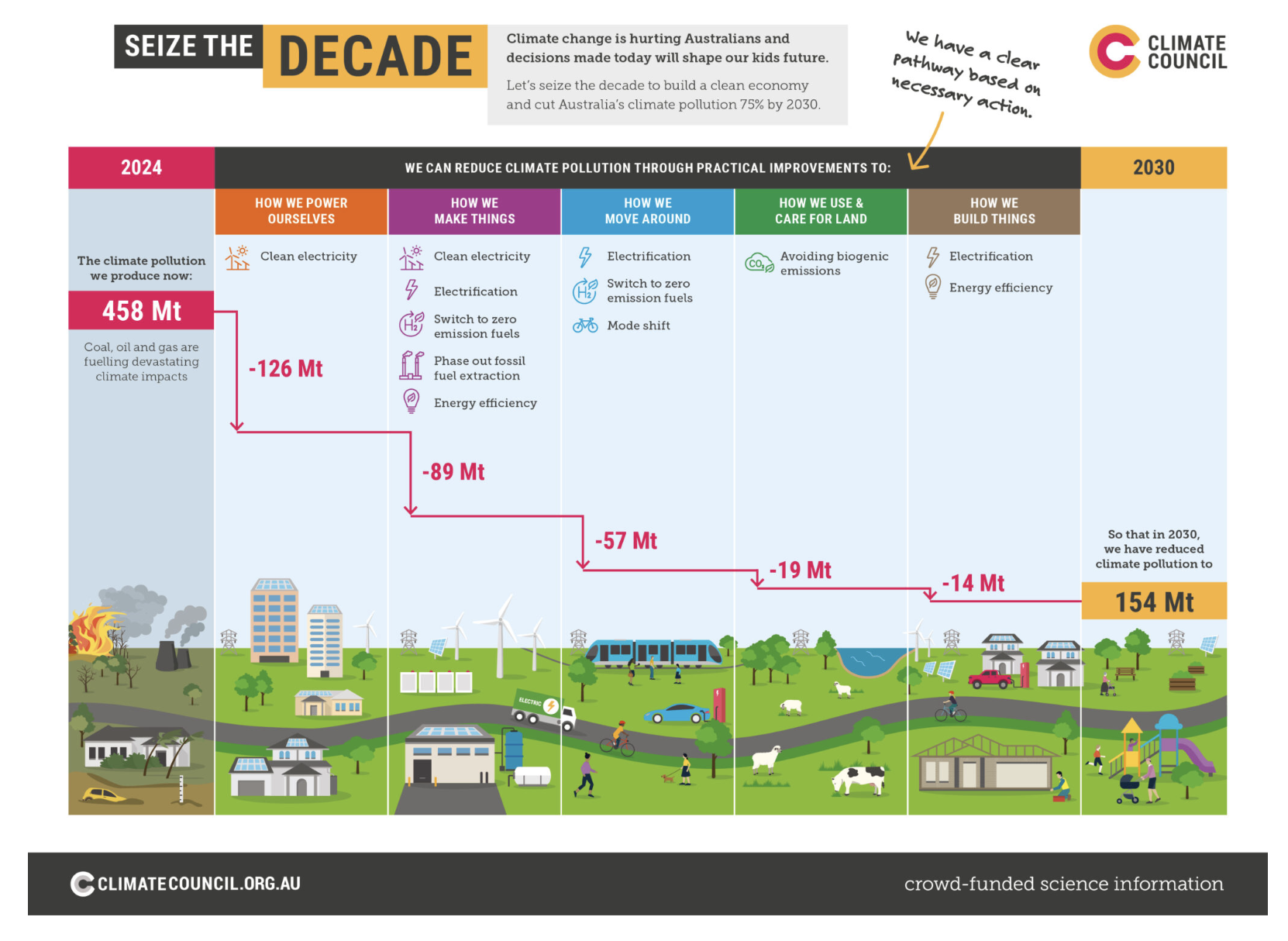
  • Banning approval of new fossil fuel projects and associated export infrastructure - and scaling down those that are already operational - to prevent locking in future emissions
  • Expanding renewable energy generation and storage, including large-scale solar, wind, hydro, and battery projects, while accelerating transmission rollout and grid modernisation for clean energy development
  • Electrifying homes and vehicles through strengthened incentives, including rebates for electric vehicles, subsidies for household electrification, and investment in nationwide charging infrastructure
  • Restoring degraded ecosystems and expanding native vegetation cover to increase natural carbon sequestration and enhance biodiversity resilience
  • Accelerating decarbonisation of industry, manufacturing, construction, transport and agriculture by deploying low-carbon materials and processes (e.g., hydrogen, electrification, circular economy practices), setting strict emissions targets, and incentivising uptake of clean technologies across all major sectors.


Economic modelling from Deloitte shows that a higher target is not only achievable, but economically advantageous: achieving a 75% emissions reduction target could unlock $370 billion in GDP and support the creation of 700,000 new jobs per year over the next decade, compared to a 65% target, reinforcing the economic case for increasing ambition beyond the current legislated range.


Why is this important?

  • Meeting the 62% - 70% target will reduce emissions and slow warming, but it still leaves Australian communities and ecosystems exposed to extreme heat, drought, fires, and sea level rise. Recent science-focused climate reporting from the 2025 weather summary released by the 
  • Modelling shows it is possible to meet and exceed the 70% upper limit of this target, and doing so could unlock significant GDP growth, job creation and opportunity for investment in clean industries like renewable energy, green hydrogen, critical minerals processing and advanced manufacturing
  • Achieving and exceeding the 2035 target will require accelerated and decisive policy implementation. 
  • Late 2025 sources state that the target alone is insufficient and needs to be “matched by credible policy frameworks” as without coordinated regulatory reform, investment certainty and strong enforcement mechanisms. Moving forward this is necessary to “turn ambition into delivery”

Desired outcomes

  • Ban or phase out new fossil fuel projects and associated export infrastructure, while managing a planned decline of existing operations to prevent locking in future emissions. 
  • Scale up renewable energy generation and storage, including solar, wind, hydro, and battery projects, with faster approval processes.
  • Electrify transport and buildings through incentives, rebates, and nationwide EV charging infrastructure.
  • Restore and expand native ecosystems to increase carbon sequestration and enhance biodiversity resilience.
  • Cut emissions across industry, manufacturing, construction, transport, and agriculture by promoting low-carbon technologies, electrification, and circular economy practices.

Who to contact: 

  • Your local Federal MPs (check on this website if you’re unsure who that is)
  • Key Federal Labor (addresses in link) including Resources Minister Madeleine King, Prime Minister Anthony Albanese; Treasurer Jim Chalmers; Climate and Energy Minister Chris Bowen; Environment and Water Minister Murray Watt; Trade and Tourism Minister Don Farrell; Industry and Innovation Minister Tim Ayres
CLICK HERE TO LOG YOUR CONTACT WITH MPs 

Resources:

Action you can take:

1. Email your MP and/or relevant Ministers:

If you need some help getting started with your email, here is an example. 

Please don’t copy it exactly - personalise it and tailor it to the MP you are writing to. 

In addition, when writing to a Minister or Shadow Minister, start by saying that you’re writing to them in their role as Minister for xxxx, otherwise they will probably just forward your email to your local MP.

[MP name]

[Member for …. or  Minister for ….]

Dear …

[Include a personal statement - who you are and why you care]


I’m extremely disappointed in the current 2035 emissions reduction target of 62-70%. This target doesn’t do enough to protect Australians, our environment, our economy, and our lifestyle from the impacts of climate change. The 62% - 70% target is in line with 2°C of warming above pre-industrial levels, which - according to the government’s own National Climate Risk Assessment - exposes us to extreme heat, drought, fires, and sea level rise. To be in line with the science, and to avoid the worst impacts of climate change, our target for 2035 should have been 100% emissions reduction, or net zero.


However, I remain optimistic because the current target represents a baseline we are capable of exceeding. I strongly encourage you to continue to advocate for ambitious, science-aligned policies and programs to surpass the 70% upper limit and place Australia on a credible path to net zero.


The most recent Modelling from Deloitte indicates that achieving a 75% emissions reduction by 2035 is not only technically feasible, but economically advantageous: achieving a 75% emissions reduction target could unlock $370 billion in GDP and support the creation of 700,000 new jobs per year over the next decade, compared to a 65% target.


To that end, I ask you:


  • What will you do to stop new fossil fuel projects and phase out existing ones that lock in future emissions?
  • What’s your plan to cut emissions across industry, transport, construction, and agriculture using low-carbon technologies and cleaner production methods?
  • How will you support the restoration of degraded ecosystems and protect native vegetation to boost carbon storage and biodiversity?


I look forward to your response.


Sincerely


Name

Address

Phone

(Note: your contact details are required if you want a reply)

2. Call your MP or Minister's office

This is a way to respond instantly to an issue and only takes a couple of minutes. 

Here is a suggested script to get you started:

Hi, my name is ….. and I’m a voter in [your electorate].


I’d like to speak to …..[name of MP]


(Staffer will probably say: I’m sorry they’re not available, can I take a message?)


Yes, thank you! Would you please tell them that:

  • I’m extremely disappointed in the recently-announced 2035 emissions reduction target, because it doesn’t do enough to protect Australians, our environment, our economy, and our lifestyle from the impacts of climate change. 
  • I’m concerned that the recently-announced 62% - 70% emissions reduction target is in line with 2°C of warming above pre-industrial levels, which - according to the government’s own National Climate Risk Assessment - exposes us to extreme heat, drought, fires, and sea level rise.


And ask them to:

  • Take bold action to exceed Australia’s 2035 emissions targets
  • Phase out fossil fuels quickly, and instead invest in clean energy infrastructure
  • Cut emissions across industry, transport, construction, and agriculture using low-carbon technologies and cleaner production methods
  • Restore and expand native ecosystems to increase carbon sequestration and enhance biodiversity resilience


Thank you!

3. Visit your MP

Nothing beats a face-to-face conversation. Email your MP’s electorate office to ask for a meeting and follow up with a phone call a few days later. Get help on how to do this under the Democracy and Governance heading on our Climate briefings webpage.

(last updated March 2026)


Fast facts on climate:

DISTURBING DATA

Global warming

Prior to the industrial revolution, the climate was relatively stable over long periods with gradual changes in temperature over thousands of years due to natural factors like changes in Earth’s orbit, volcanic activity, and solar radiation. However, since the late 19th Century, human activities - especially the burning of fossil fuels and large-scale deforestation - have released huge amounts of greenhouse gases into the atmosphere. As a result, in 2024, Earth was about 1.47°C warmer than before the Industrial Revolution in the late 19th century, a rate of warming so rapid it outstrips every other warming period in the planet’s history.


Aboriginal flag Torres Strait Islander flag

We acknowledge the Traditional Custodians of Country throughout Australia, whose sovereignty was never ceded. We acknowledge that Indigenous peoples around the world are at the forefront of climate change, both in experiencing its effects and leading solutions for change. We pay our sincerest respects to all Elders, past and present.